 VOLUME 30, ISSUE 3 • September 2026. Full issue »

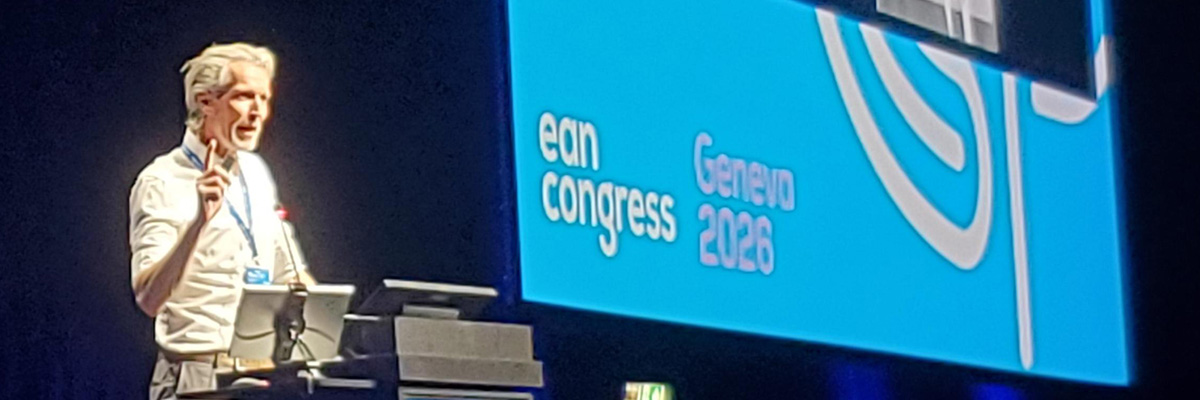
When even Marsden would not have a clue: Reflections from the David Marsden Lecture
Delivering the David Marsden Lecture is one of the greatest honors in our field. C. David Marsden was one of the true giants of neurology, and his influence extends far beyond his extraordinary scientific output. In this lecture, I wanted to share not only a systematic approach to difficult neurological diagnoses, but also some of the lessons that have shaped me as a clinician. If there is one message I would like colleagues — particularly younger colleagues — to remember, it is this: find and emulate your heroes.
I have done this throughout my career. I do not believe we should try to become copies of our mentors. Instead, we should be eclectic: identify qualities we admire in different people, learn from them, and then add our own skills, preferences and personality — our own “sauce.” That combination ultimately shapes who we become as physicians.
David Marsden was one of my heroes. I met him only once, when I was a 21-year-old researcher presenting my first poster. He shook my hand and spent a few minutes talking with me. It was a tiny moment in his career, but a defining one in mine. It taught me something I still try to practice today: make time for young people. Marsden published more than 1,000 papers, many of exceptional quality, but I believe his greatest legacy may be the people he trained and inspired. Investing in the next generation is investing in the future of our field.
I have been fortunate to have many other heroes. Bill Langston – the famous scientist to discover to the MPTP story – taught me how to write a scientific paper and stimulated my interest in environmental contributors to Parkinson’s disease. Axel Wintzen, my great mentor at Leiden University Medical Centre where I was trained as a resident, taught me to think for myself and to remain genuinely interested in the person behind the diagnosis. Kailash Bhatia showed me what it means to combine an extraordinary breadth of neurological knowledge with remarkable depth. Andrew Lees taught me the value of remaining intellectually rebellious and curious, while the late Nir Giladi reinforced my conviction that optimal Parkinson’s care is multidisciplinary and that the person living with the disease must be part of the team.
But my truly greatest heroes are people living with Parkinson’s and other neurological diseases. In our center, we do nothing for people with Parkinson’s; we do everything with people with Parkinson’s. This extends to research. We involve people with lived experience in deciding whether a research question is worth asking, in designing studies, in interpreting the findings and, where appropriate, as co-authors of our publications.
The second message of my lecture was about returning to the fundamentals of clinical neurology. When faced with a difficult diagnostic problem, start by listening. Careful history-taking remains one of our most powerful diagnostic tools. Even seemingly trivial details can matter. Ask people in which direction they fall. Backward falls may suggest PSP or frontal pathology; lateral falls may point toward vestibular or cerebellar dysfunction or freezing during turning; an apparently vertical collapse should make us consider orthostatic hypotension, syncope, or negative myoclonus.
Sometimes an even simpler question can be informative. I noticed that people with Parkinson’s who began putting on their trousers while sitting rather than standing seemed more likely to develop falls. We subsequently studied this observation and found that, although certainly not a perfect predictor on its own, it can contribute useful information about fall risk. This is the kind of small clinical pearl that reminds me why careful listening matters.
Observation is equally important. I often tell my residents that the hospital may be the perfect place to get the wrong idea about Parkinson’s disease. Freezing of gait can disappear precisely when we ask someone to demonstrate it. Falls, sleep disturbances, freezing of gait, and response fluctuations may all remain invisible during a conventional consultation. This is why home videos and observations from everyday environments can be so valuable.
As neurologists, we should behave a little like Sherlock Holmes. Look at the shoes: characteristic wear may reveal chronic foot dragging caused by spasticity. Watch the arms during walking and turning. Arm abduction — the so-called “gunslinger’s gait” — can reflect perceived postural instability and provide clues to atypical parkinsonism. Even before the formal examination starts, observe how someone gesticulates during conversation. Reduced spontaneous or “social” movements may reveal subtle asymmetry.
And do not only look — listen. I increasingly believe that sometimes we can hear a neurological diagnosis even more readily than we can see it. Foot drop, spasticity, ataxia, and parkinsonism can produce characteristic sounds during walking. Diagnostic information is all around us if we train ourselves to recognize it.
The same discipline is essential when diagnosing functional neurological disorders. A functional diagnosis should never be made simply because something looks unusual or because we do not understand it. We should look for positive features, particularly inconsistency and variability. At the same time, we must be cautious about labeling something “incongruent.” What appears incompatible with neurological disease today may become understandable tomorrow.
One case illustrated this particularly well. A woman presented with striking episodes of criss-cross gait that initially made me consider a functional disorder. However, repeated home videos showed that the phenomenon was remarkably consistent. Looking deeper ultimately led to the diagnosis of GLUT1 deficiency syndrome. The lesson was simple: unusual does not mean functional, and uncertainty should stimulate curiosity rather than premature closure.
This, ultimately, is what I wanted my Marsden Lecture to convey. When even David Marsden might not immediately have had the answer, return to the basics: listen carefully, observe carefully, examine the person in their real environment, ask colleagues for help, use ancillary testing judiciously, and allow time and treatment response to inform the diagnosis.
Technology will transform neurology, but it should never make us look at the screen instead of the person in front of us. And our legacy will not be measured only by publications or citations. It will also be measured by the people whose lives we improve and by the young clinicians we inspire.
Find your heroes. Learn from them. Add your own sauce. And, eventually, try to become a hero for someone else.
Read more Moving Along: