

 VOLUME 30, ISSUE 3 • September 2026. Full issue »

Updates from the MDS-PAS leadership
Updates from the:
- Chair - Irene Litvan, MD
- Chair-Elect - Maria Cecilia Peralta, MD
- Immediate Past Chair - Alberto J. Espay, MD
My reflections and vision for the Pan American Section
By Irene Litvan, MD,
MDS-PAS Chair
My journey in Movement Disorders has been shaped by a commitment to understanding Parkinson’s disease (PD) beyond its motor manifestations. Early in my training, I became aware that cognitive and neuropsychiatric symptoms profoundly affect patients and families, yet were often under-recognized in clinical practice and research. This realization directed my academic path toward defining and operationalizing mild cognitive impairment in PD and advancing longitudinal research in cognition.
Through collaborative work within the International Parkinson and Movement Disorder Society (MDS), particularly in consensus-building initiatives and task forces, I witnessed firsthand how structured international cooperation can transform clinical science. Developing criteria, harmonizing methodologies, and engaging multidisciplinary colleagues across continents strengthened my belief that progress in our field requires both rigor and collaboration.
My leadership philosophy has been shaped by three principles: scientific excellence grounded in patient-centered outcomes; interdisciplinary collaboration; and mentorship. The Pan American region is uniquely diverse in scientific productivity, healthcare systems, and access to specialized care. This diversity presents both challenges and tremendous opportunities.
My priorities for the Pan American Section focus on:
- Strengthening regional research networks to harmonize data collection and expand collaborative cohort studies (i.e., MSA cohort study).
- Advancing equitable access to education through bilingual programming, hybrid platforms, and targeted outreach to underserved areas.
- Promoting integration of cognitive and other non-motor dimensions into routine clinical practice.
- Expanding structured mentorship and leadership opportunities for early-career professionals.
- Enhancing communication and shared identity across the Americas.
The future of Movement Disorders lies not only in biomarker discovery and therapeutic innovation, but also in building inclusive scientific communities. I look forward to fostering a Pan American Section that is collaborative, forward-looking, and committed to improving the lives of patients and families throughout the region.
Reflection on My Journey and Vision
When I began my career in neurology, PD was often described in terms of tremor and rigidity. Yet in the clinic, what I saw were patients and families struggling with memory changes, executive dysfunction, behavioral shifts — aspects of the disease that were deeply impactful but insufficiently addressed. That clinical reality shaped my career.
My work on mild cognitive impairment in PD grew from those encounters. Contributing to international consensus criteria and longitudinal studies was not merely an academic exercise; it was an effort to give structure and recognition to symptoms that patients were already experiencing. Through MDS, I found a global community committed to advancing knowledge while maintaining clinical relevance.
Serving within the Society has been one of the most meaningful aspects of my professional life. It has reinforced that leadership is about listening, building bridges, and creating opportunities for others. Mentoring trainees across the Americas and collaborating with colleagues from diverse healthcare systems has deepened my appreciation for both our shared goals and our regional disparities.
My vision for the Pan American Section (PAS) is rooted in inclusion and connection. We must ensure that scientific advances reach all parts of our region. We must empower early-career clinicians and researchers. We must continue integrating cognitive and non-motor dimensions into mainstream care. And we must strengthen collaboration so that innovation does not remain siloed.
Most importantly, we must remember we do this work for patients and families whose lives are shaped by these disorders every day. I approach this role with humility, dedication, and a commitment to further build the PAS Section to reflect both excellence and equity.
Strategic Priorities for the Pan American Section
My career in Movement Disorders has focused on advancing understanding of cognitive impairment in PD, improving knowledge of atypical parkinsonian disorders, contributing to the development of diagnostic criteria, and promoting longitudinal and translational research. Through leadership roles within MDS, I have gained insight into the essential elements for sustainable scientific progress: standardized practices, mentorship programs, and regional collaboration.
The PAS faces distinct structural challenges: heterogeneity in healthcare access, variability in training opportunities, and unequal research infrastructure. Addressing these requires a deliberate and strategic framework.
My objectives for my term include:
1. Research Infrastructure Development
- Promote multicenter consortia across the Americas.
- Standardize data collection frameworks to enhance cross-study comparability.
- Increase regional participation in global clinical trials.
2. Educational Equity
- Expand bilingual and hybrid educational offerings.
- Develop targeted programming for low-resource settings.
- Establish structured grant-writing and manuscript workshops.
3. Workforce Development
- Formalize mentorship networks for early-career members.
- Create leadership development pathways within the Section.
- Encourage representation from underrepresented regions in committees and panels.
4. Clinical Practice Advancement
- Disseminate practical tools for cognitive and non-motor symptom management.
- Promote multidisciplinary care models adaptable to diverse healthcare systems.
5. Organizational Cohesion
- Enhance communication channels within the Section.
- Establish thematic working groups to facilitate sustained collaboration.
- Increase visibility of Pan American contributions within global MDS initiatives.
Sustained impact will depend on measurable goals, transparent governance, and active member engagement. I am committed to advancing a PAS that is scientifically rigorous, operationally inclusive, and strategically aligned with the evolving landscape of Movement Disorders research and care.
What MDS meant to me: The experiences that led me to a leadership role
By Maria Cecilia Peralta, MD,
MDS-PAS Chair-Elect
Great things rarely start grand; they usually begin quietly, and my journey to leadership was no exception.
It was very early on when I was a young girl that I decided I wanted to understand how the brain functions. I wanted to discover the complexities of human interactions and how to improve personal well-being. Perhaps, in an unnoticed way, I wanted to create solutions to some of daily life’s challenges.
During medical school, while studying psychiatry, I was fascinated by its theoretical foundations. However, unexpectedly, the reality of its practice did not fulfill me. Then, it was totally clear to me that I wanted to pursue a career in neurology, and very early in my neurology training, with the leading mentorship of Oscar Gershanik, I had the opportunity to see many patients with movement disorders.
I still remember every Tuesday at noon, when Oscar Gershanik led the Movement Disorders Grand Rounds at the French Hospital in Buenos Aires, where video cases were presented and discussed. At that time, I was still a young resident, quietly sitting in the last row, almost like an outsider looking in. Even so, I felt drawn in by the experience. I was fascinated by how the brain could give rise to such unusual movements, and I was equally captivated by the discussions on phenomenology that Dr. Gershanik and senior neurologists such as Gonzalo Gómez Arévalo and Silvia García, among others, would engage in. It was at that moment when I decided to pursue a fellowship in Movement Disorders.
Along the way, I have felt incredibly fortunate. I have met so many remarkable people who have shaped my career, individuals I am proud to call my mentors, colleagues and friends, like Werner Poewe and Birgit Högl, Gregor Wenning, and Klaus Seppi.
When I first went to Innsbruck, Austria, for an additional training in movement disorders, Birgit Högl, whom I had met during her training in sleep in movement disorders with Dr. Gershanik in Buenos Aires, played an important role in facilitating my first steps there.
During my time training with Werner Poewe and his team, I had the opportunity to grow in ways I never imagined, such as taking on multiple projects and becoming involved in international collaborations and research. There, I learned not only how to manage responsibilities, but also how to do so with a sense of purpose and grace. In many ways, that experience shaped the way I relate to others.
When I came back to Buenos Aires, I found myself in a different personal and professional stage of my career. At that time, I became more directly involved with MDS, serving as a member of the Education Committee. From that moment on, I took on many other roles across various committees.
I have also become more engaged with the Movement Disorders Group at the Argentinian Neurological Society (ANS).
Argentina has a longstanding tradition in the field of neurology. The Movement Disorders Group, initially founded by Dr. Gershanik and colleagues in 1983, is currently composed of dynamic, vital, and dedicated neurologists with an interest in movement disorders. They represent the main neurological clinics in Buenos Aires and across the country.
Several years ago, working with a group of motivated colleagues, we took the initiative to create the first registry of Parkinson’s disease patients within the ANS, at a time when registries in other neurological diseases were also being developed.
The registry was established using an online database that enabled the standardized collection of medical and epidemiological data on Parkinson’s disease. More than 13 hospitals participated in the registry, and several abstracts and sessions were presented at local and international congresses. In developing this project, I would like to warmly acknowledge the dedication of Nelida Garretto, Diego Bauso, Tomoko Arakaki, Emilia Gatto, and Anabel Chade, among other colleagues.
All these experiences inspired and led me to decide I wanted to do something even more significant for patients living with movement disorders in Argentina.
I realized at that moment that there were no imaging biomarkers for people with Parkinson’s other than MRI or CT scans. And more importantly, colleagues were not familiar with the use of more sophisticated imaging for the diagnosis of parkinsonism.
Then, with the help of colleagues at CEMIC University Hospital, we conducted the first research study using FDOPA-PET imaging in Parkinson’s disease in Argentina, in collaboration with Maria Bastianello, my counterpart in the department of Nuclear Medicine. At that moment, it had required a huge effort in fundraising, writing the research protocol, and carrying out the study. And MDS supported us through an Outreach Educational Program, the Visiting Professor Program, which allowed us to present the first meeting in Argentina on the use of imaging biomarkers in parkinsonism, with Antonio Strafella as the visiting professor.
All these efforts gave to patients and the medical community the possibility to access a biomarker that could increase the accuracy of detection of parkinsonism. This is a powerful example of what MDS has meant to me, and it demonstrates how education and networking can inspire lifetime changes, in a person and in a society.
This development led to another initiative, which was to contribute, together with members of the Neuroimaging Study Group of MDS, to a sort of “democratization of knowledge” in the use of imaging techniques for parkinsonism. We co-authored a paper on the “Pragmatic approach on neuroimaging techniques for the differential diagnosis of parkinsonism,” which was recognized as the most impactful review and research paper published in Movement Disorders Clinical Practice for the term 2021-2022, which aimed at making neuroimaging tools understandable and more accessible for neurologists and movement disorder specialists in their daily practice.
Looking back, these examples highlight one of the most fascinating aspects of MDS, and it is how it brings together wonderful and bright people, people you can truly connect with — kind, open, and very focused on movement disorders. Over time, these connections become something more meaningful. Personally, I think this is one of the Society’s greatest assets. It creates not just professional or educational opportunities, but a genuine sense of community. And because of this, I believe it stands out in a very special way, one that many other societies may look upon with interest.
MDS has also meant other things during my journey. It meant being a woman from Argentina, South America, a non-native English speaker, and opening doors I once thought were far beyond my reach. As a woman, I did not feel any barriers. It gave me the opportunities to present my research at meetings where for the first time, I saw the names I had only known from papers, come to life.
After all these efforts, I felt that something shifted for me; I felt that I truly belonged. It was a meaningful moment that aligned well with my vocation for service. From there, I knew that I was ready to take the next step in my journey and pursue an international leadership position, through which I hope to contribute to the education of the next generation of movement disorders clinicians.
As the Pan American Section looks forward, our focus turns to preparing the next generation of movement disorders clinicians to meet the demands of an increasingly data-driven practice in neurology and movement disorders. Future movement disorders clinicians may need to evolve from being “expert diagnosticians” to becoming “care coordinators and team leaders” and “technology-literate” physicians, while cultivating “soft skills” such as empathy and compassion, to ensure they continue talking to patients and caring for them.
This perspective also connects to another priority for the PAS strengthening interprofessional training and collaboration through education programming. This includes closer collaboration with allied health professionals, basic scientists and non-specialists clinicians to produce interprofessional education that reflect the realities of modern care delivery.
The PAS Section is highly heterogeneous, and the Latin American region is also markedly uneven. While major cities and large capitals have excellent hospitals and access to medical education, rural or underserved areas face shortages of movement disorder specialists, technology, and treatments. In consequence, another priority is to support education and new training programs in underserved regions to cope with these inequities.
Many things and challenges lie ahead. The path has not been easy and it likely will not be. However, I remain optimistic about the development of emerging trends and look forward to helping advance progress and seeing some of these initiatives become a reality.
Looking back to a chapter of service in the MDS Pan-American Section
By Alberto J. Espay, MD,
MDS-PAS Past Chair
Serving as Chair of the Pan American Section of the International Parkinson and Movement Disorder Society (MDS-PAS) was one of the most meaningful professional experiences of my career. It offered an opportunity not only to help advance the field of movement disorders across an extraordinarily diverse region, but also to witness firsthand the intellectual generosity, resilience, and creativity of our colleagues throughout the Americas. Trying to fill in the shoes Susan Fox left behind was both an honor and a challenge!
 The PAS occupies a unique place within the MDS. Our region encompasses countries with vastly different healthcare systems, educational infrastructures, economic realities, and access to specialized care. Yet despite these differences, I consistently observed a shared commitment to improving the lives of patients with movement disorders and to advancing scientific rigor, education, and collaboration.
One of the most rewarding aspects of this role was helping strengthen connections across countries and generations. I was particularly encouraged by the energy and leadership emerging from our young clinicians and investigators throughout Latin America and North America, from countries big and small. Their commitment to clinical excellence, research innovation, and international collaboration gives me great optimism about the future of our field.
Our Section also continued to expand educational initiatives, regional engagement, and opportunities for multidisciplinary participation. Membership grew to more than 3,910 members, amounting to more than a third of the entire MDS membership. Educational initiatives also expanded beyond established centers into smaller countries and emerging groups. In fact, our MDS-PAS Affiliate Societies are now 13 in total. This came to its highest expression during the PAS Congress in Cartagena, Colombia, the first outside the United States. I profusely thank the heavy work of Cecilia Peralta as Chair of the Program Scientific Committee and Gabriel Jose Arango as Chair of the Local Organizing Committee. We had the opportunity to welcome 560 delegates from 29 countries in Cartagena for a meeting featuring 18 scientific sessions and 208 posters.
This journey, however, also came with a few challenges, not least the restrictions imposed by budgetary constraints and the need to tighten our expenses for the Houston MDS-PAS Conference earlier this year. But the MDS-PAS is thriving, and there has been increasing interest in the committees, study groups, and task forces from across the membership.
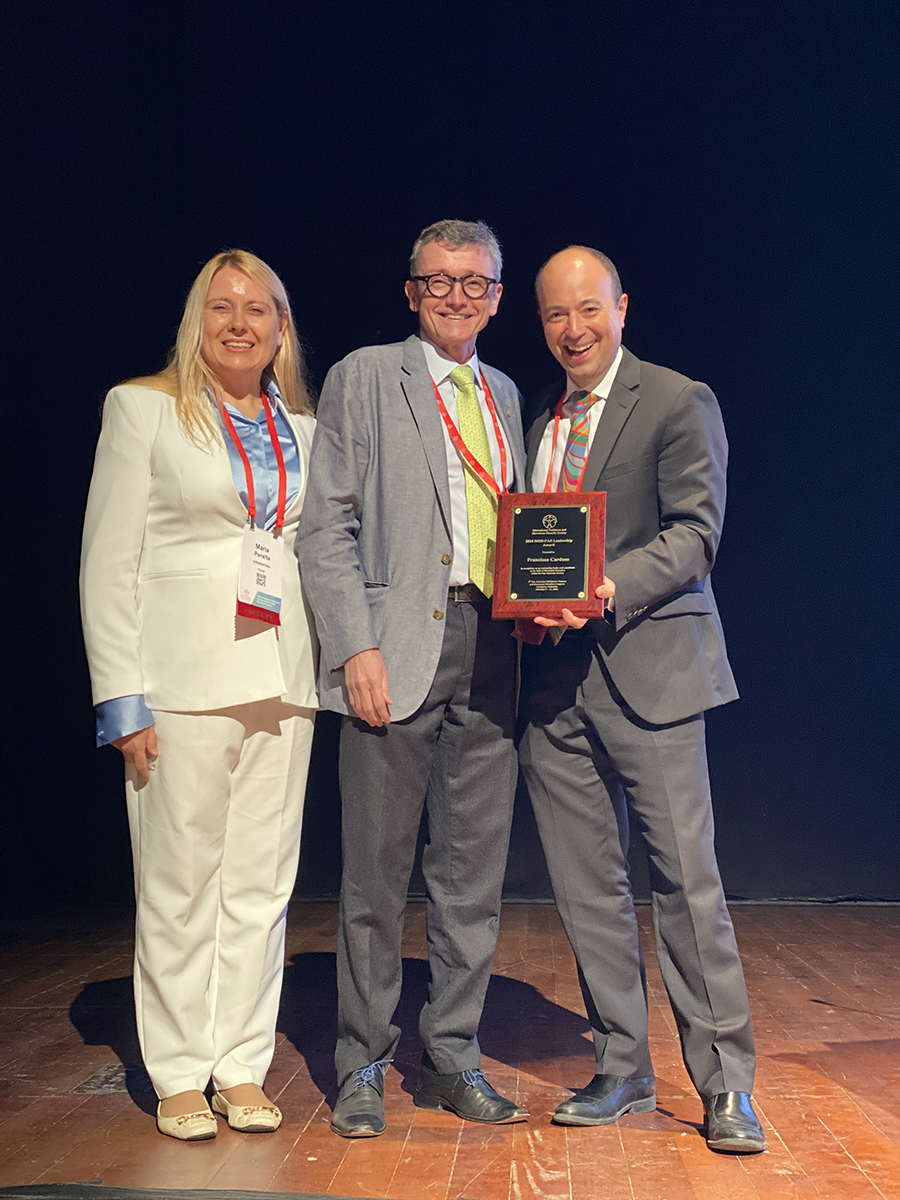
After concluding my chapter as the section’s Chair, I felt deep gratitude to the many colleagues, mentors, committee members, and friends who made this experience so rewarding, and just the spirit of collegiality that defines our special field. I am especially thankful to Annette Schott, Jenny Quebbeman, Shannon Fraaza, Maddy Kolb, and Jennie Socha, whose professionalism and support made the work both effective and enjoyable (and made me look as if I knew what I was doing). We have an administrative team that makes our work both efficient and enjoyable, as you can see in the photos taken in Cartagena. Lastly, I feel fortunate to have shared this experience with and benefited from the unwavering support of Victor Fung, the MDS President during my tenure.
I offer the Chair and Chair-Elect Drs. Irene Litvan and Cecilia Peralta, much success in leading our Section to even greater things. Ultimately, our role is to serve both patients and colleagues.
I left this role profoundly optimistic about the future of the Pan American Section and grateful to have been part of its journey.
Discover the latest from the MDS-Pan American Section:
Read more Moving Along: