
 VOLUME 29, ISSUE 4 • DECEMBER 2025.

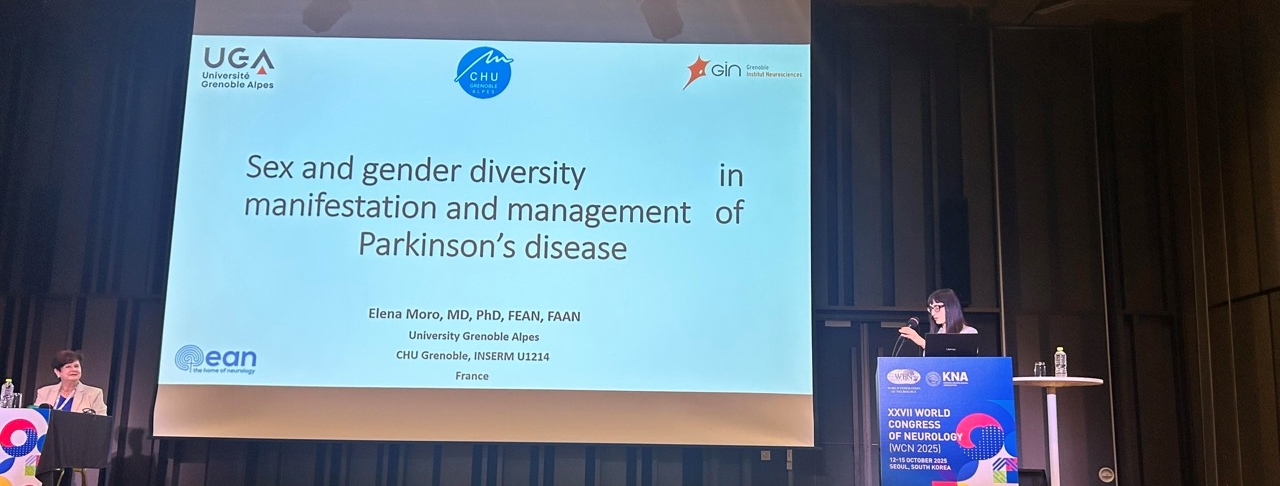
The 27th Congress of the World Federation of Neurology was October 12-15, 2025 in Seoul, Korea.
Although this is a congress with a broad range of topics, from the different subspecialities of neurology to medical education, brain health, and advocacy, it also included several sessions on movement disorders, with important members of the Movement Disorder community joining this event.
To highlight a few, the Movement Disorders topic kicked off on the first day with two brilliant lectures on “Environmental Toxins and Parkinson's Disease,” with Prof. Caroline Turner providing a brilliant lecture of the long history of the association of PD and toxins, followed by Prof. Sun Ju Chung, who lectured about the impact of air pollution as potential risk factor for PD.
The highlight of the second day was the video round sessions, both devoted to non-motor symptoms, with the presence of Profs. Miyasaki (hypokinetic), Albanese (hyperkinetic), and Pal (rare MD) in the first round; and Professors Moro (neuropsychiatric symptoms in PD), Fung (non-motor symptoms in other MD), and Fanciulli (sleep, pain, and dysautonomia in PD) in the second.
Very early on the third day, the Joint WFN/EAN special session was also on movement disorders, with Prof. Elena Moro discussing the gaps and challenges of treating females and women with Parkinson disease, Prof. Kailash Bhatia presenting the challenges of taking care of people with rare movement disorders, and finally, Prof. Rajeev Ohja brilliantly lecturing about the worldwide disparities in the treatment of people with movement disorders, providing examples from Nepal.
Furthermore, there were two MDS/WFN sessions, the first one on the clinical and biological definition of Parkinson disease, lectured by MDS Past-President Dr. Victor Fung. That was followed by an update on the current state of biomarkers in PD by Prof. Daniela Berg, then finally, technological assessment and monitoring of PD using digital health technologies with Prof. Roongroj Bhidayasiri.
The second special session was on inpatient movement disorder consultations and included three lectures. The first was on the approach to the encephalopathic patient with tremor and jerks by Prof. Zakiyah Aldaajani. The second was on dementia and parkinsonism differential diagnosis by Prof. Kigocha L. Okeng’O . The third was on autoimmune movement disorders by Prof. Yih-Ru Wu.
Finally, on the last day, the topic was once again epidemiology and epigenetics, with a session entitled “Why Are Parkinson’s Disease Rates Changing? Age, Environment, (Epi)Genetics?” with lectures on mechanisms of neurotoxicity and environmental risk factors for PD.
Many of these lectures will be available at the WFN website.
The World Congress of Neurology will be back in two years, next time in lovely Cape Town, South Africa.
Read more Moving Along: