






 VOLUME 30, ISSUE 3 • September 2026. Full issue »

MDS convenes Task Force on Parkinson’s Disease Exposome Integration
The number of people with Parkinson’s disease (PD) worldwide appears to have increased substantially over the last decades. There is growing evidence that exposure to environmental toxicants – such as pesticides, metals, solvents, and air pollution – play an important role in the development of PD. However, several important questions remain unanswered.
It remains unclear which specific environmental toxicants are most harmful, and whether exposure to multiple toxicants at the same time increases the risk more than exposure to a single agent. There are also remaining questions on how these toxicants enter the body, and how they affect the brain. Other questions relate to the timing of exposure. Growing evidence suggests that toxicants may contribute to the risk of PD only after individuals have been exposed for many years – or even decades. This makes it difficult to identify exactly when and how environmental factors influence the risk of PD.
The risk of PD is also influenced by other external exposures, in particular lifestyle and social factors, such as diet, physical activity or living conditions. The full range of environmental, lifestyle, and social exposures experienced throughout life is collectively known as the ‘external exposome.’ Intriguingly, some people appear more vulnerable to external exposures than others. In other words, certain external exposures may be more harmful for people who already have a genetic predisposition to PD. Therefore, there are open questions on how toxicants interact with a person’s “internal exposome,” in particular, with their genetic makeup and physiology.
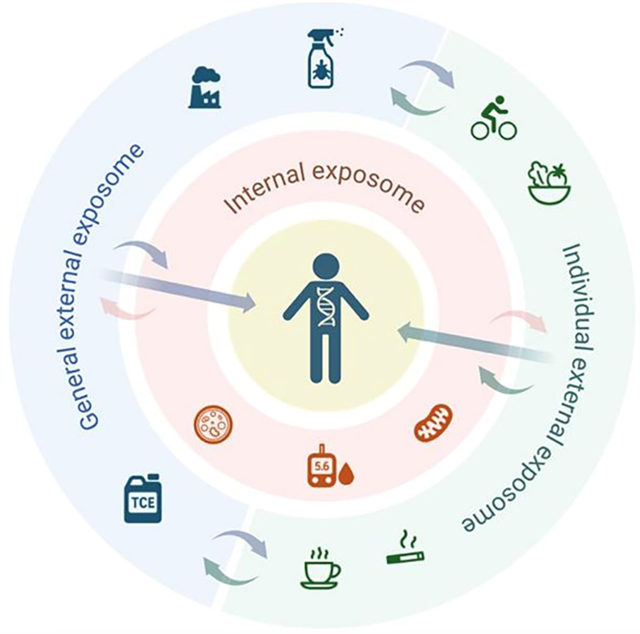
Illustration of the potential interdependencies between human health and genetic disposition (yellow), the internal exposome (red), and the general (blue) and individual (green) external exposome. Exposure to specific risk factors does not always fall within a specific domain. For example, exposure to toxicants such as pesticides or solvents can be part of the general exposome domain, if there is widespread contamination of soil/water/air, or belong to the individual external exposome, e.g., in the case of specific occupational exposure of an individual person.
Addressing these questions requires collaboration between experts from different scientific fields. Epidemiologists can identify patterns on (mixtures of) specific exposures in populations, toxicologists can investigate whether specific toxicants directly cause harm in laboratory models, geneticists can study how genes influence susceptibility, biostatisticians can analyze the large and complex datasets involved, and neurologists can help interpret clinical findings. It is also important to study the effects in populations from different parts of the world. Environmental risks linked to PD are not the same everywhere. For example, people living in heavily urbanized areas may be more exposed to air pollution, while those in agricultural regions may experience higher exposure to pesticides. Understanding these regional differences is essential for identifying the most important risk factors and developing effective prevention strategies.
The MDS Task Force on Parkinson’s Disease Exposome Integration brings together leading researchers from a wide range of scientific fields and geographical regions to address these challenges. By combining data from existing studies, developing new collaborative research projects, and sharing innovative research methods, the Task Force aims to improve our understanding of how environmental factors contribute to PD risk and progression. Ultimately, this work will help to identify potential causes of PD, integrate into emerging clinicobiological definitions of PD, and support the development of strategies to reduce the burden worldwide.
Scientific background:
Atterling Brolin K, Schaeffer E, Kuri A, Rumrich IK, Schumacher Schuh AF, Darweesh SKL, Kaasinen V, Tolppanen AM, Chahine LM, Noyce AJ. Environmental Risk Factors for Parkinson's Disease: A Critical Review and Policy Implications. Mov Disord. 2025 Feb;40(2):204-221. doi: 10.1002/mds.30067
Okubadejo, N.U., Schaeffer, E., Noyce, A.J., Heinzel, S., Burn, D.J., Fung, V.S., Postuma, R.B. and Berg, D. (2026), Addressing Gaps in Parkinson's Disease Etiology: The Need for a Polyexposure Score. Mov Disord, 41: 1085-1090. https://doi.org/10.1002/mds.70231
Read more Moving Along: