 VOLUME 29, ISSUE 4 • DECEMBER 2025.

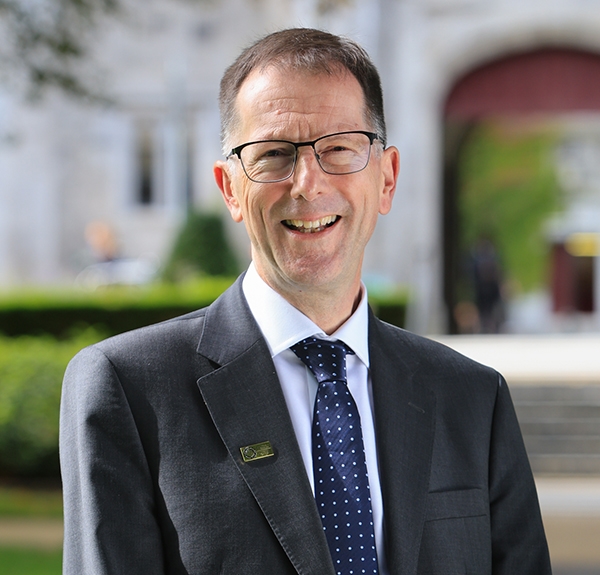
Professor David Burn has been President of the University of Galway, Ireland, since September 2025. Prior to this he was Pro-Vice Chancellor of the Faculty of Medical Sciences at Newcastle University. After designation by NIHR and NHS England in March 2020, David was Director of Newcastle Health Innovation Partners, the Academic Health Science Centre for the Northeast of England and North Cumbria. David is a Fellow of the Academy of Medical Sciences and Emeritus NIHR Senior Investigator. He chaired the NIHR Translational Research Collaboration for Dementia 2017-2023 and the Northern Health Science Alliance Board 2018-2024. He has been President of the International Parkinson and Movement Disorder Society (MDS) since October 2025.
Where it all began
Q: Could you walk us through your career journey up to this point? What first drew you into Parkinson’s and Movement Disorders, and what continues to keep you inspired and energized in this field?
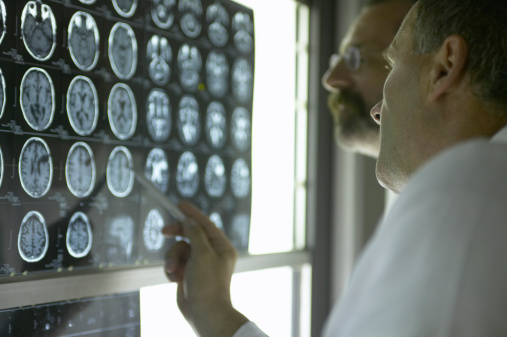
I first became interested in Movement Disorders when doing clinics with David Brooks during my time at the Hammersmith Hospital, London. This led to me to doing an MD with David, using 18F-dopa PET scanning to detect subclinical parkinsonism. When I returned to Newcastle upon Tyne, UK, I set up the first movement disorders clinic in the region. It was always the patients that inspired me to learn more and to do better for them.
Q: Your career spans clinical care, research, and significant university leadership positions. Looking back, which experiences have shaped you the most, and which do you think you’ll draw on most as you step into your work with the MDS?
I couldn’t give a single experience, but the words of an ex-football manager, Marco Bielsa, come to mind here: “The moments in my life when I have improved are closely related to failure; the moments in my life when I have regressed are closely related to success. Being successful deforms us as human beings: it relaxes us, it plays tricks on us, it makes us worse individuals, it feeds our egos. Failure is the complete opposite: it forms us, makes us more solid, brings us closer to our convictions, makes us more coherent.”
So, I would say that I have learned most from challenging times, developed greater resilience through these experiences, and tried hard to maintain balance, positivity, and calm with those around me, even under significant pressure.
Finally, undertaking a senior leadership role, particularly in the university context, means you must let go of your own self-interest and rejoice in, and celebrate, the success of others.
Q: The ICICLE-PD study has become a landmark in our understanding of cognition in Parkinson’s disease. What sparked the idea for the study, and were there insights that changed or deepened the way you think about Parkinson’s disease?
My interest in cognitive impairment in Parkinson’s came from working with colleagues in Newcastle like Ian McKeith, Elaine and Robert Perry, and Jim Edwardson, amongst others. When Parkinson’s UK decided to make a major investment in dementia research, focusing on clinical and biomarker predictors of dementia, working with Professor Roger Barker and colleagues in Cambridge was a natural partnership. The study was driven by the major unmet clinical need associated with this devastating symptom. The study findings deepened my appreciation that Parkinson’s is not simply a motor disorder, but a complex, multisystem disease in which cognition plays a central role.
Stepping into the MDS Presidency
Q: What motivated you to put your hand up for the role of MDS President?
I always remember saying to a Staff Development Officer in Newcastle when she asked me what my aspiration was many years ago that I wanted to be President of the MDS. I thought my chance had gone when I moved into my Pro-Vice Chancellor role in Newcastle. But the MDS is like a family that continues to value and embrace you, and so when I had undertaken my PVC job for enough time to know at least how to perform the routine elements of the job, I decided to throw my hat into the ring for the MDS President role.
Q: From your perspective, what are the MDS’s greatest strengths, and where do you see the most exciting opportunities for the Society to make an impact?
Its collegiality, global reach, inclusiveness, and its focus on education. Helping to deliver the new MDS Strategy, which I was proud to be a part of shaping, is where I see my opportunity to make the greatest impact.
Q: As you look ahead, which MDS initiatives are you most enthusiastic about advancing during your presidency?
I would like to work with our Past-President, Victor Fung, to deliver a biological framework for the diagnosis of Parkinson’s and Lewy body-related diseases, and to further develop the patient and carer initiative that Victor started — this is a big undertaking. I would also like to increase our membership across the world, and critically appraise how AI can help, and not hinder, our field.
Q: Every field evolves and faces challenges. What do you see as the biggest challenges for the MDS and the broader Movement Disorders community in the coming years? How do you think the MDS can best position itself to meet them?
Geopolitical and associated economic instability. MDS is being proactive in facing up to these challenges and looking to ensure financial sustainability for our society.
Community, Leadership, and Advice
Q: The MDS is known for its strong international community. What do you enjoy most about being part of it, and are there any moments in your leadership journey that stand out to you?
It is an absolute privilege to have so many good friends in so many different parts of the world and to enjoy traveling to meetings in beautiful and fascinating locations. Having been an Officer of the society at different times has meant that I have visited places that I probably would never have had the chance to otherwise. Working with excellent colleagues from so many different parts of the globe has given me a chance to improve my own practice and knowledge.
Q: The MDS has invested heavily in developing leadership within our field through highly successful initiatives such as the LEAP Program. You’ve held major leadership roles as Pro-Vice Chancellor of Newcastle University for many years, recently the President of the University of Galway, and now MDS President. Across these experiences, what have you learned about what makes an effective leader?
Active listening, clarity of vision, good communication, and treating everyone the same, regardless of their background or role. Trying to remain positive and cheerful outwardly, even when you are under severe pressure.
Q: What advice would you give to young clinicians or researchers who are just entering the Movement Disorders field?
Anything is possible and follow your dreams. Try to secure a good mentor or two from outside your place of work, even in an informal sense. Never try to stay in your comfort zone for too long and aim to surround yourself by people brighter than yourself, and who might challenge your way of thinking.
Q: And finally, as you begin your tenure as President, what message would you like to share with the global MDS community?
Being President of our Society is a huge honor. Through previous leaders and senior colleagues, the MDS has given me many opportunities over the years to develop. I will do my best to use that experience to help to develop others, and to grow our society in every way.
Read more Moving Along: