


 VOLUME 30, ISSUE 1 • March 2026. Full issue »

Session Highlight: 2026 PAS Congress
AI is just a tool, but it matters how we use it
The final plenary session of the MDS PAS Congress, “Artificial Intelligence (AI) in Movement Disorders,” featured lectures on how AI came to be and how it works, how our field has already incorporated AI into clinical practice and research, and how AI in the future may be able to bridge the North-South gap.
Speakers included Drs. Mitra Afshari (USA), Mayela Rodriguez Violante (Mexico), and Santiago Perez-Lloret (Argentina), with a lively discussion following. Several questions from the audience brought in the controversial topics of data trust and the ethics of outsourcing work to AI.
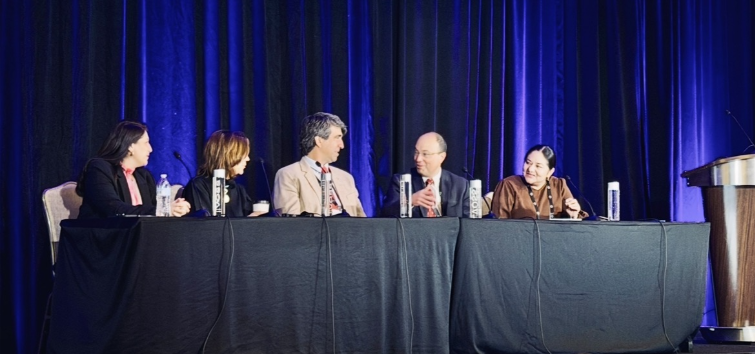
Pictured left to right, speakers Drs. Afshari, Violante, and Perez-Lloret answer audience questions moderated by the plenary chairs, Drs. Espay and Pena, during the “Artificial Intelligence in Movement Disorders” plenary session on February 15, 2026.
The Essence of AI: How it Works and Where It’s Headed
The first lecture by Dr. Afshari was a masterclass on how the concept of AI was born in the 1940s and how it came to exponentially scale to its current magnitude in the 2020s. From simple feedback loops to state-and-rule systems to supercalculators and finally to neurons and neural networks, the foundations of AI were discussed in detail and the audience was able to walk away with a greater understanding of how AI systems operate and the technologies that have fueled their abilities to simulate intelligence at their current capacity.
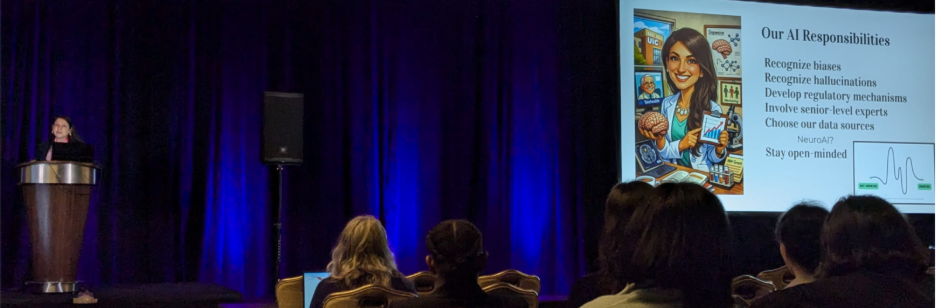
Dr. Mitra Afshari presents our ever-growing AI responsibilities as we look to future, highlighting the need for developing consensus-based regulatory mechanisms and perhaps even recommendations for optimal data sources.
She discussed the future of AI in Movement Disorders, highlighting that the incorporation of AI represents a paradigm shift away from visual phenomenology towards more precision movement disorders care models. She also outlined the steps in the AI tool development pipeline (training, validation, deployment, and monitoring), as well as common biases and pitfalls that may enter during these steps and compromise AI’s accuracy.
Finally, Dr. Afshari ended the lecture summarizing our “AI responsibilities” as we enter into this future era where many of us will undoubtedly be both using and creating AI tools, which included developing regulatory mechanisms and choosing our data sources based on expert consensus. A key take-away weaved throughout Dr. Afshari’s was that neurologists are in fact the most well-positioned to understand how AI works, to embrace it, and to remain engaged in debates in the future given our deep understanding of neural networks and intelligence.
How Clinicians are using AI in Practice and Research
The second lecture by Dr. Violante beautifully highlighted how the paradigm shift towards precision medicine has been realized through use-case examples of different AI models. She structured her talk into three parts — describing how currently available AI tools can assist clinician and researchers to (1) produce, (2) search, and (3) integrate data — not just adding muscle power to the capabilities our human brains already have, but unleashing reconstructive capabilities to reveal new information layers.
In terms of producing data, Dr. Violante discussed several examples of deep phenotyping in parkinsonian disorders and digital biomarkers. She also reviewed machine learning as applied to neuroimaging for the early detection and monitoring both in the clinic setting and especially in the setting of therapeutic clinical trials in Huntington’s disease. The analysis of multimodal datasets — i.e. multi-omics — via machine learning models were described in the setting of prediction models to identify prognostic biomarkers, for example more rapid cognitive decline in Parkinson’s disease, which cannot traditionally be derived in the clinic setting alone.
In terms of searching data, Dr. Violante took us through a very comprehensive review of all of the different ways AI can be used to search, synthesize, and even present published evidence, ultimately powered by large language modeling. She reviewed AI-powered tools to assist in literature searches, answer very specific questions, perform systematic reviews and meta-analyses, and even extrapolate new research questions by identifying mechanistic overlaps. These tools can search across millions of publications — a feat that would simply be impossible by the hands of a single researcher.
Lastly, in terms of integrating data, the application of AI as a clinical decision support system (CDSS) was introduced with deep brain stimulation being the perfect use-case example. From pre-operative planning to improve targeting using 7T MR imaging of patient anatomy to AI-powered automated algorithms to adjust settings based on clinical benefit and side effect profiles, Dr. Violante presented how AI carries strong promise to improve deep brain stimulation across several domains of care.
Can AI Bridge the North-South Gap in the PAS Region?
The final lecture was delivered by Dr. Perez-Lloret, who was able to summarize the key ideas and use-case examples presented in the preceding two lectures and take the discussion one step further, providing thoughts on how AI tools can provide more uniform access, more equitable care, and more diverse research representation.
With clinical visits only representing the tip-of-iceberg of what patients experience, he discussed how the growth of wearable devices has allowed us to truly capture real-life patient experiences, with at least eight of these devices now being FDA- and EMA-approved. As a growing expert in computer vision systems, Dr. Perez-Lloret discussed how computer vision could help standardize the movement disorders examination, especially with respect to Parkinson’s disease, where examination accuracy, especially in the setting of clinical trial outcomes, is so crucial. Additional emerging technologies along the spectrum of computer vision, like computer audition systems and mobile health “apps,” were also introduced as new ways AI could transform patient assessments in the future. With less than 50% of movement disorders patients having access to a Movement Disorders specialist in both North and South America, one of Dr. Perez-Lloret’s take-home messages was that AI tools have the potential to close the access gap and improve care for our patients.
The overarching message from the plenary session was that AI is not a replacement for clinical judgment, but rather it is a tool that is only useful if it is developed carefully, used responsibly, and interpreted critically. The session stressed that AI systems should be actively understood instead of passively used, that clinical expertise is still necessary to guide their development and validation, and that fairness should be a top priority when using these technologies in different healthcare systems. Ensuring that AI-training datasets include diverse populations will be essential to avoid bias and to maintain the applicability of AI tools in underrepresented regions, including populations from many South American countries.
In the end, the future of AI in Movement Disorders will depend not only on how well the technology works, but also on the standards, accountability, and goals of the clinicians and researchers who choose to use it.

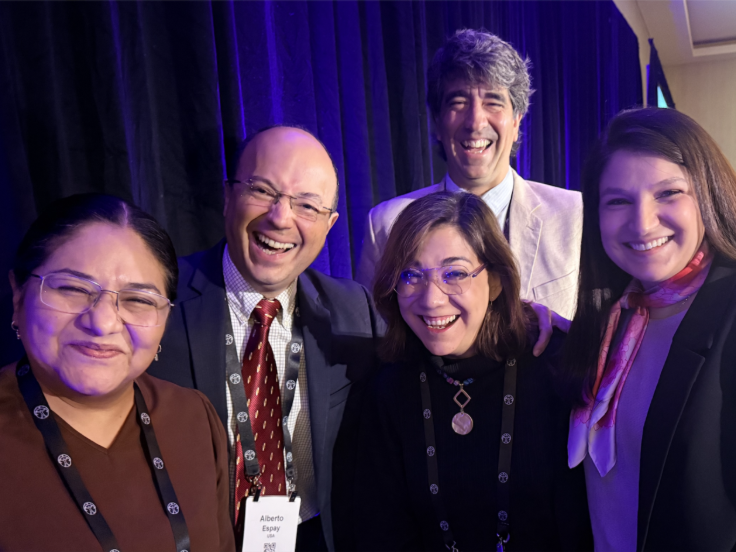
An AI-generated cartoon of the speakers, Drs. Afshari, Violante, and Perez-Lloret, together with plenary chairs, Drs. Espay and Pena, portrayed riding the roller coaster that is AI. As Dr. Afshari mentioned in her lecture, “The space between knowing and not knowing when it comes to AI can feel scary like a roller coaster, but like a roller coaster, it can also be fun."
Read more Moving Along: