


 VOLUME 30, ISSUE 1 • March 2026. Full issue »

Accelerating discovery in infection-related movement disorders
MDS Infection-Related Movement Disorder Study Group continues ambitious collaborative output, including the development of a unified consensus framework and award-lauded paper
The MDS Infection-Related Movement Disorders (IRMD) Study Group was formed in 2021 to address a critical gap in our field. Since then, it has grown from a small initiative into a vibrant international collaboration of nearly 200 members across six continents. This expansion reflects the global relevance of IRMD.
The group's foundation was laid by founding chairs Prof. Pramod Pal and Prof. Susanne Schneider, whose vision established IRMD as a distinct clinical entity within movement disorders neurology. Their emphasis on scientific rigor and international collaboration continues to shape the group's work today, under the leadership of Dr. Soaham Desai and Dr. Elena Cecilia Rosca.
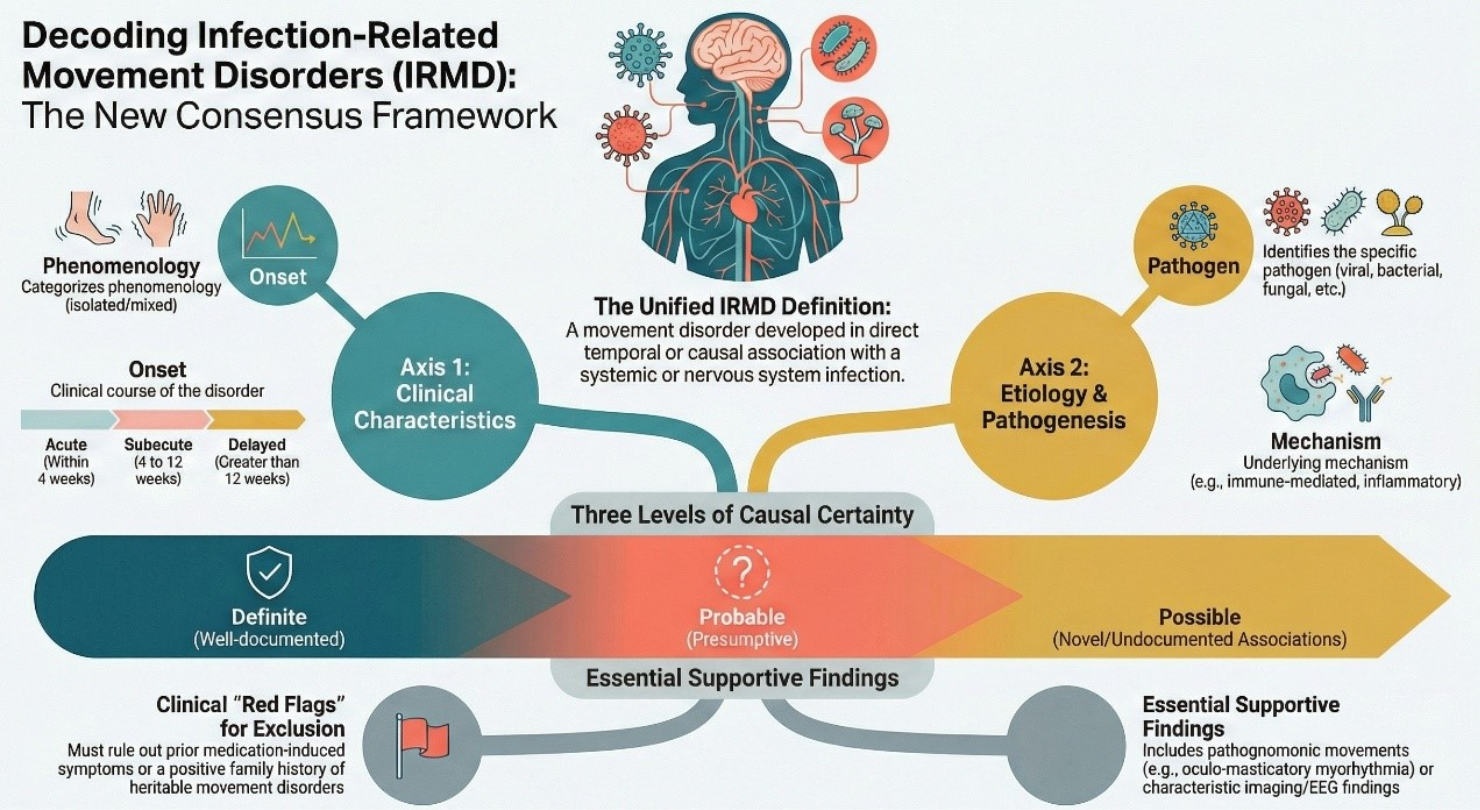
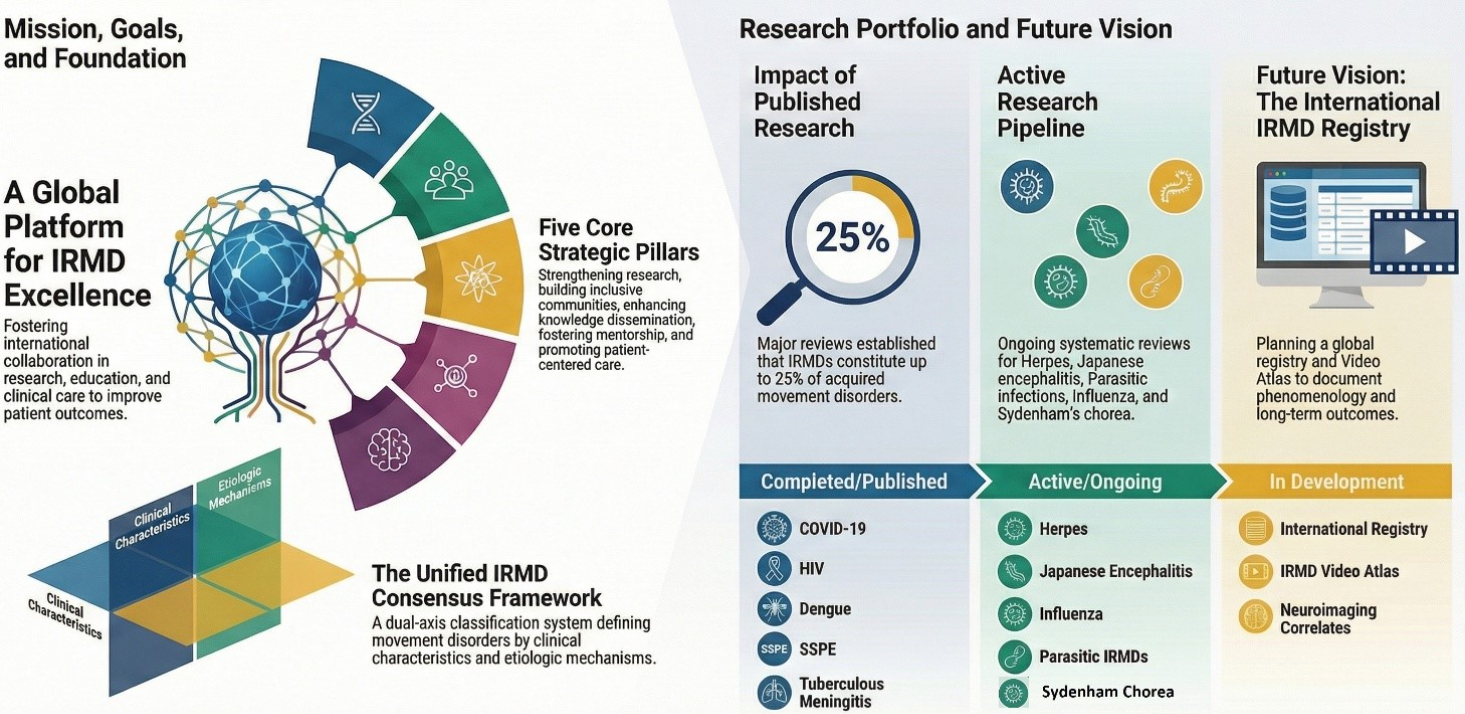
One of the study group's early contributions has been the development of a unified consensus framework for definition, diagnosis and axis-based classification of IRMD. This groundbreaking work establishes a standardized approach to defining, classifying, and diagnosing infection-related movement disorders. The framework also establishes three levels of causal certainty (Definite, Probable, and Possible) based on essential supportive findings, creating a standardized language that transcends geographical and institutional boundaries. This framework introduces a dual-axis classification system that provides clinicians with a structured approach to diagnosis. [Desai et al, PRD, 2024]. This framework has created a common language for clinicians worldwide.
The group's scholarly output has steadily expanded. Dr. Divyani Garg led an international survey of MDS members revealing that IRMDs constitute up to 25% of acquired movement disorders in many practices, particularly in endemic regions [Garg et al MDCP]. Dr. Charulatha Sankhala, Dr. Garg, and Prof. Pal led a review on subacute sclerosing panencephalitis (SSPE)–related movement disorders that earned the 2025 MDCP Best Review Paper award.
Additional contributions include the Prof. Rosca-led scoping review on dengue-associated movement disorders (Movement Disorders journal), Dr. Desai-led scoping review of tuberculous meningitis–related movement disorders (MDCP), and reviews on HIV-associated movement disorders (Amod and Holla) and long-term outcomes of post-COVID movement disorders (Schneider et al).
|
— Dr. Soaham Desai, Chair, IRMD Study Group |

Currently, the group is working on several collaborative research projects. Dr. Ravi Yadav, Dr. Desai and colleagues are examining herpes virus-associated movement disorders. Dr. Vikram Holla, Prof. Pal, and team are conducting a systematic review of Japanese encephalitis-related movement abnormalities. Dr. Onanong Phokaewvarangkul and group are synthesizing global evidence on Sydenham's chorea. Prof. Rosca and Dr. Santiago Perez-Lloret are investigating influenza-associated movement disorders. Further projects exploring parasitic IRMDs (Dr. Desai) and neuroimaging correlates of IRMD (Dr. Garg) are also currently ongoing.
|
— David Sackett, pioneer of Evidence-Based Medicine |
|
— Prof. Cecilia Rosca, Co-Chair, IRMD Study Group |
Education remains central to the group's mission. Bi-monthly video case discussions led by Dr. Holla, Dr. Garg, Dr. Phokaewvarangkul, and Dr. Jirada Sringean provide accessible learning on diverse IRMD presentations for study group members worldwide.
Looking ahead, the group's priorities align closely with the MDS 2025-2029 Strategic Plan. We aim to strengthen global research collaborations, particularly with colleagues in underrepresented regions. We are exploring ways to incorporate patient perspectives into research priorities and developing plans for an international IRMD registry / IRMD video atlas to document phenomenology, natural history, and outcomes across diverse populations.
The IRMD Study Group exemplifies how focused collaboration can address specialized clinical challenges with global relevance. As emerging infectious threats continue to reshape neurological practice, our work becomes increasingly vital to advancing movement disorders care worldwide.
We warmly invite MDS members at all career stages to join our study group. Together, we can transform uncertainty into clarity for patients with IRMD.
Read more Moving Along: