
 VOLUME 30, ISSUE 1 • March 2026. Full issue »

Primary brain calcification consensus released during undiagnosed movement disorders symposium in China
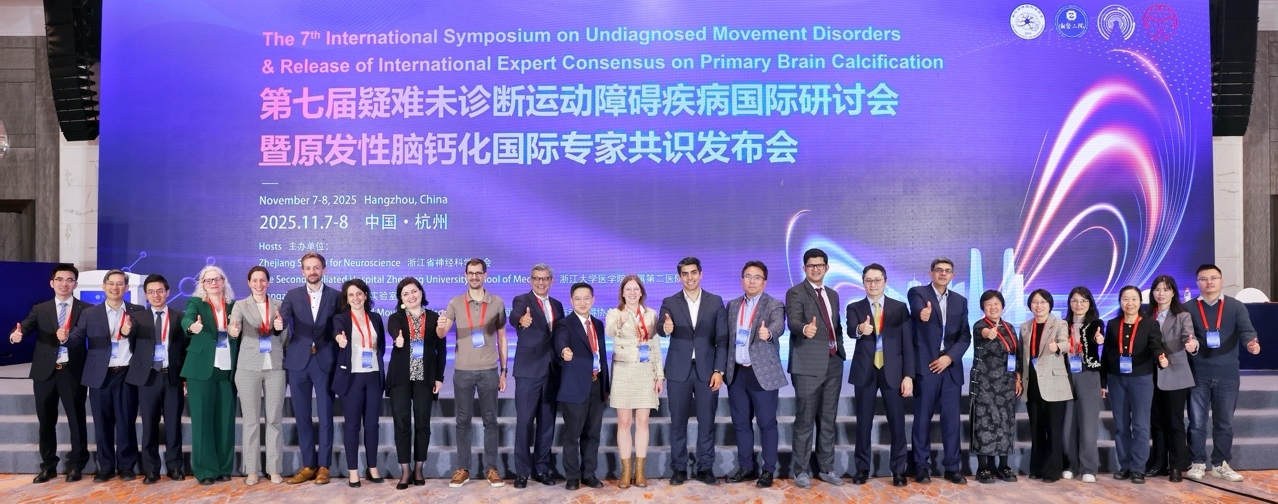
On November 8 2025, the 7th International Symposium on Undiagnosed Movement Disorders took place on the scenic shores of West Lake in Hangzhou, China. The meeting marked a major milestone with the release of the “International Expert Consensus on Primary Brain Calcification” and brought together clinicians and researchers to share the latest advances in complex movement disorders, with a strong emphasis on genetics and precision medicine.
Convened by Prof. Wei Luo and his team, this MDS-endorsed symposium was hosted by the Zhejiang Neuroscience Society, the Second Affiliated Hospital of Zhejiang University School of Medicine, and Liangzhu Laboratory. More than 20 international experts from 11 countries joined more than 200 enthusiastic attendees from 27 provinces across China, creating a highly interactive meeting with lively discussions throughout the day.
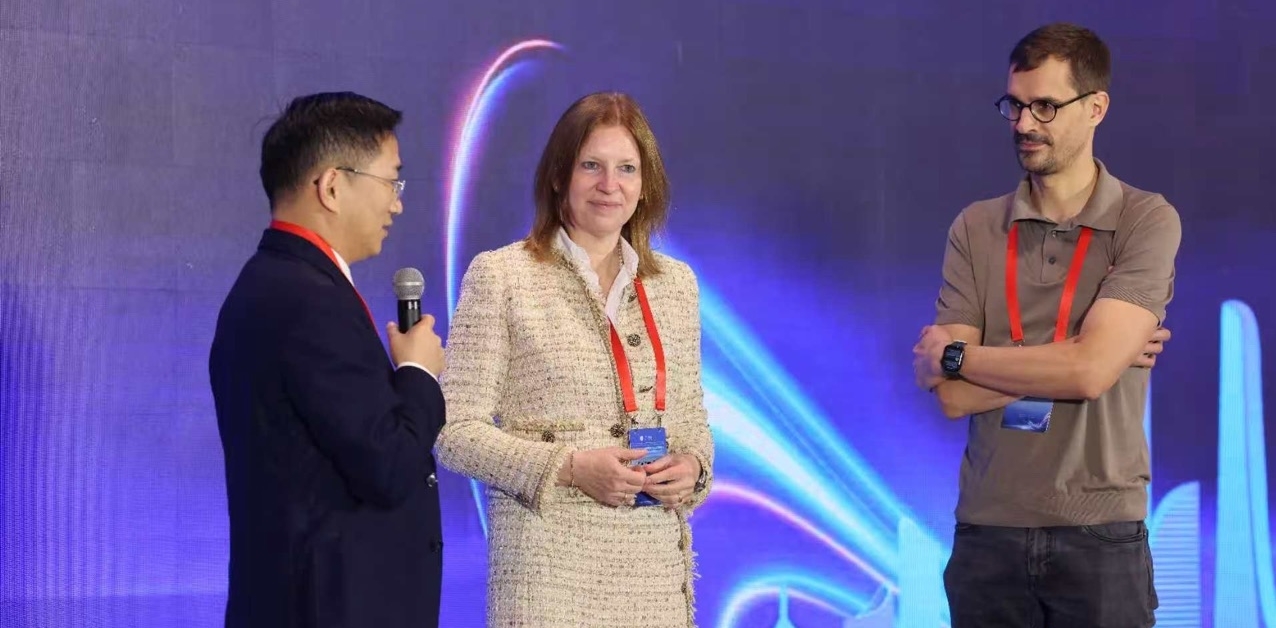
The symposium opened with a video address from Jian’an Wang, academician of the Chinese Academy of Sciences and President of the Second Affiliated Hospital of Zhejiang University School of Medicine, who welcomed faculty and attendees and congratulated the community on the release of the consensus criteria. Prof. Victor Fung, the MDS Past-President, also provided online remarks emphasizing the importance of sustained international collaboration and China’s growing engagement with the global movement disorders community.
As the centerpiece of the meeting, Prof. Luo presented the history of primary brain calcification as a disease entity and the journey toward international consensus, accompanied by commentary from members of the consensus panel. This was followed by the official release ceremony for the first “International Expert Consensus on Primary Brain Calcification.”
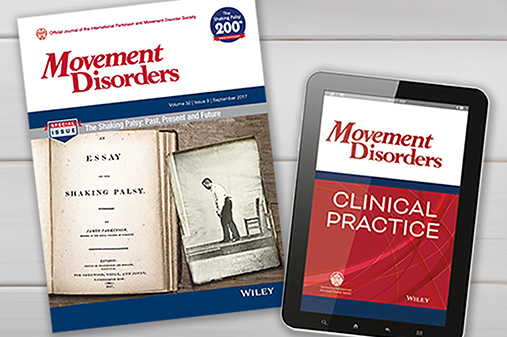
Led by Prof. Luo in partnership with 23 experts from 10 countries, the consensus was developed over two years and seven months (April 2023 - November 2025) through extensive iterative drafting, international coordination, and four rounds of Delphi questionnaires. It represents the first unified global effort to try to standardize how primary brain calcification is described, diagnosed and managed — harmonizing nomenclature, diagnostic criteria, imaging standards, genetic testing and counseling, and clinical management. The consensus provides a shared framework for clinicians and researchers and represents an important step in the global effort to transform primary brain calcification from an under-recognized radiological finding to a clinically approachable and eventually treatable neurodegenerative disease. The consensus is now published and available in Movement Disorders.
The subsequent scientific program was rich in educational content. Prof. Gaël Nicolas (France) reviewed the genetic basis and phenotypic spectrum of primary brain calcification. Prof. Christine Klein (Germany) drew on advances in movement disorders genetics and her own career journey to illustrate how clinical questions can drive discovery and practice-changing insights. Prof. Shen-Yang Lim (Malaysia) provided an Asia-focused update on progressive supranuclear palsy, while Prof. Taku Hatano (Japan) reviewed the pathological mechanisms and emerging biomarkers of Parkinson's disease. Prof. Giulietta Riboldi (USA) shared the clinical insights and updates on genetics of myoclonus, and Prof. Kailash Bhatia (UK) focused on rare but treatable movement disorders, emphasizing phenotype-driven diagnoses and targeted genetic/biochemical testing — messages that resonated strongly with the audience.
Additional sessions further consolidated the symposium’s translational emphasis. Prof. Xuewen Cheng (China) outlined mechanistic and therapeutic advances in primary brain calcification, including astrocyte-regulated phosphate homeostasis and emerging antisense strategies. Prof. Amit Batla (UK) presented a structured bedside approach to hyperkinetic movement disorders, while Prof. Shivam Mittal (UAE) discussed individualized management of tremor and dystonia. Prof. Elie Matar (Australia) summarized practical diagnostic considerations for cognitive dysfunction across Parkinson’s disease, parkinsonism, and Lewy body dementia.
Taken together, this symposium highlighted a shared vision of closer alignment between China and the global movement disorders community through sustained scientific exchange and collaboration, underscoring shared efforts to translate scientific discovery into improved patient care.
Read more Moving Along: