

 VOLUME 30, ISSUE 1 • March 2026. Full issue »

From patient to research: Exploring a four-strain probiotic's effects in Parkinson’s disease
The concept of this trial is rooted in a genuine patient-clinician collaboration. In 2016, the late Jon Hiseman, the legendary drummer of the iconic jazz-rock band Colosseum, spoke to us about his wife, the late Barbara Thompson, who had advanced Parkinson’s disease (PD) and was under our care. Barbara was herself a celebrated saxophonist and leader of Paraphernalia, and she performed at the opening ceremony of the Stockholm MDS Congress in 2014. Jon reported that Barbara had experienced a marked improvement in both the effects of levodopa and her general well-being after taking a four-strain probiotic containing Lactobacillus acidophilus, Lactiplantibacillus plantarum, Lacticaseibacillus rhamnosus, and Enterococcus faecium. This observation prompted us to review the emerging evidence on gut microbiota and probiotics in PD [1] and to seek funding for a controlled clinical trial, following a successful preclinical study conducted in collaboration with University College London [2].
Gastrointestinal dysfunction and pro-inflammatory alterations of the gut microbiota are increasingly recognised as integral features of PD, spanning all stages of the condition, from prodromal to advanced disease [3,4]. The central hypothesis of this project was that gastrointestinal dysfunction, along with other motor and non-motor symptoms (NMS), may be influenced by the gut microbiota and could therefore be partly addressed through gut-modulating interventions such as probiotics. While probiotics are already considered a useful therapeutic option for constipation in PD [3] and are endorsed in the wellness prescription for PD [5], the mechanisms underpinning their potential broader benefits remain unclear.
We designed and conducted a multicenter, randomised, double-blind, placebo-controlled trial at King’s College Hospital and King’s College London (UK), in collaboration with Skåne University Hospital, Lund (Sweden). Seventy-four patients with PD and constipation were randomised to receive either the four-strain probiotic or placebo orally for 12 weeks. The primary outcome measure was the differential abundance of gut microbiota taxa between baseline and week 12 in the active versus placebo groups. Secondary outcomes included changes in plasma levels of inflammatory cytokines. Exploratory outcomes comprised changes in plasma and faecal short-chain fatty acids (SCFAs), as well as motor and NMS measures.
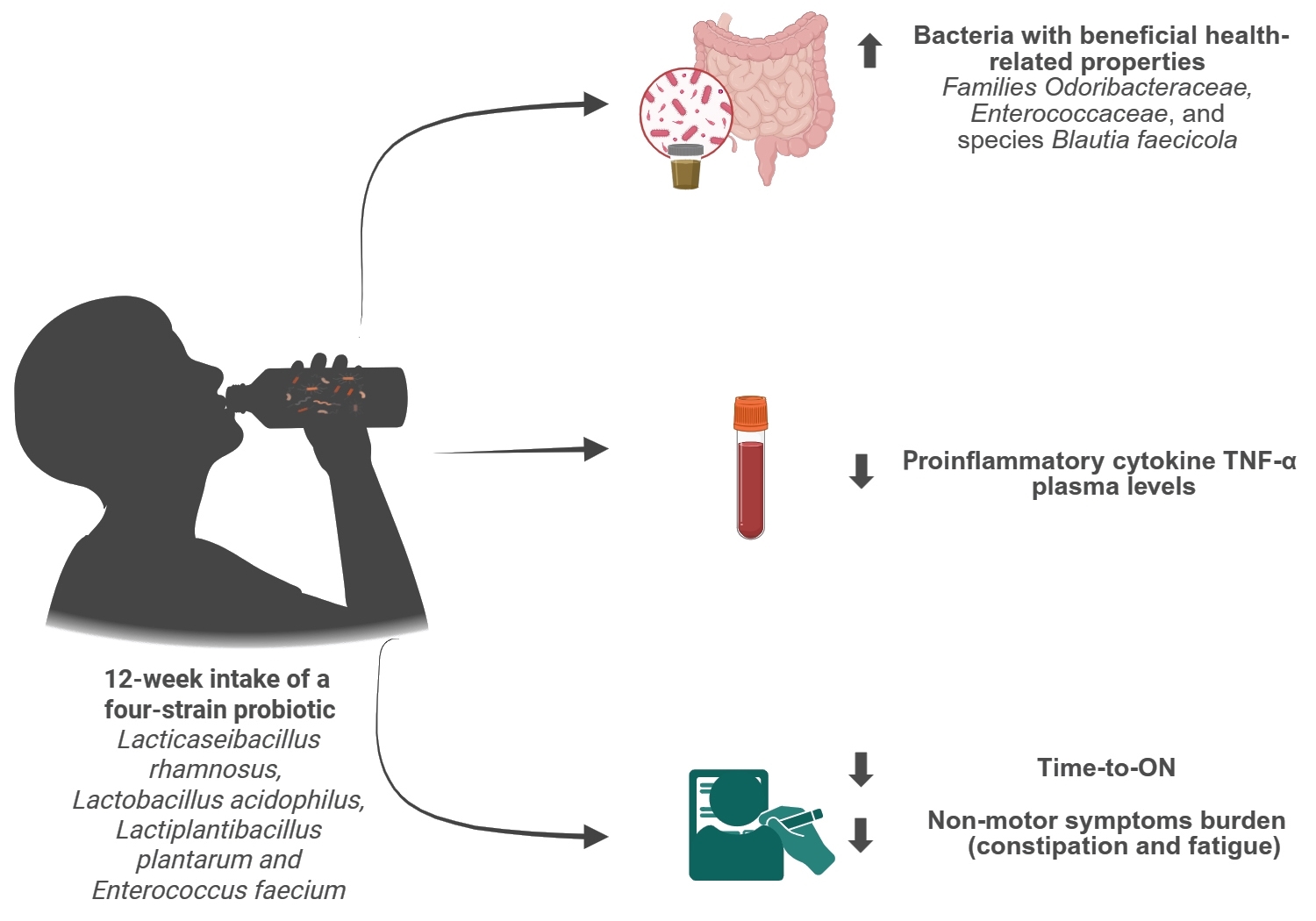
We observed enrichment of bacterial taxa with recognised health-associated properties (including Odoribacteraceae, Enterococcaceae, and Blautia faecicola) in the active group compared with placebo. In addition, plasma levels of the pro-inflammatory cytokine TNF-α decreased following probiotic treatment. No significant changes were detected in SCFA levels. Clinically, reductions in time-to-on following levodopa administration and in overall NMS burden — driven primarily by improvements in constipation and fatigue — were observed in the active group.
The findings of the SymPD trial suggest that this four-strain probiotic can beneficially modulate the gut microbiota, with potential downstream effects on systemic inflammation, levodopa response time, and non-motor symptom burden in patients with PD and constipation. These results support further investigation of probiotics as a novel adjunctive therapeutic strategy in Parkinson’s disease.
References
- Leta V, Ray Chaudhuri K, Milner O, Chung-Faye G, Metta V, Pariante CM, Borsini A. Neurogenic and anti-inflammatory effects of probiotics in Parkinson's disease: A systematic review of preclinical and clinical evidence. Brain Behav Immun. 2021 Nov;98:59-73. doi: 10.1016/j.bbi.2021.07.026. Epub 2021 Aug 5. PMID: 34364965.
- Ghyselinck J, Verstrepen L, Moens F, Van Den Abbeele P, Bruggeman A, Said J, Smith B, Barker LA, Jordan C, Leta V, Chaudhuri KR, Basit AW, Gaisford S. Influence of probiotic bacteria on gut microbiota composition and gut wall function in an in-vitro model in patients with Parkinson's disease. Int J Pharm X. 2021 Jul 2;3:100087. doi: 10.1016/j.ijpx.2021.100087. PMID: 34977556; PMCID: PMC8683682.
- Wang Q, Luo Y, Ray Chaudhuri K, Reynolds R, Tan EK, Pettersson S. The role of gut dysbiosis in Parkinson's disease: mechanistic insights and therapeutic options. Brain. 2021 Oct 22;144(9):2571-2593. doi: 10.1093/brain/awab156. PMID: 33856024.
- Leta V, Klingelhoefer L, Longardner K, Campagnolo M, Levent HÇ, Aureli F, Metta V, Bhidayasiri R, Chung-Faye G, Falup-Pecurariu C, Stocchi F, Jenner P, Warnecke T, Ray Chaudhuri K; International Parkinson and Movement Disorders Society Non-Motor Parkinson's Disease Study Group. Gastrointestinal barriers to levodopa transport and absorption in Parkinson's disease. Eur J Neurol. 2023 May;30(5):1465-1480. doi: 10.1111/ene.15734. Epub 2023 Mar 7. PMID: 36757008.
- Subramanian I, Ricciardi L, Schrag A, Appel-Cresswell S, Kola S, Domingos JM, Pickut BA, Dahodwala N, Bocoum A, Falup-Pecurariu C, Bronner G, Pontone GM, Mischley LK, Garretto NS, Modugno N, Dolhun R, Wijeratne T, Tull V, McDaniels B, Chaudhuri KR; International Parkinson; Movement Disorder Society Task Force on Wellness. A Holistic Wellness Prescription for Parkinson's Disease: Evidence-Based Perspectives and Unmet Needs. Mov Disord Clin Pract. 2025 Oct 14. doi: 10.1002/mdc3.70381. Epub ahead of print. PMID: 41084417.
Read more Moving Along: