


End of life preferences of people with Parkinson's disease



Ms. Nicole Duff: Hello, and welcome to the MDS Podcast, the official podcast of the International Parkinson and Movement Disorder Society. I am your host, Nicole Duff, from the Wits Donald Gordon Medical Centre in Johannesburg, South Africa. And today, I am very excited to be able to spend some time with Dr. Marjan Meinders, who is working as a researcher at Radboud University Medical Centre in the Netherlands.
View complete transcript
Thank you so much for taking the time to meet with us today. I really appreciate it.
Dr. Marjan Meinders: Thank you for the invitation. It's an honor to share my experiences with you in this podcast
Ms. Nicole Duff: So today we're going to be discussing the really exciting article that you were collaborating on, titled Documented End-of-Life Preferences of People with Parkinson's Disease or Parkinsonism Across Europe. [00:01:00] And I think that it really caught our eye because it hasn't so much in the past, but really now in the last few years gained traction looking at end of life and palliative care, especially within the Parkinson's field.
And so I think the article itself was fascinating in the aspect that it's the start, as you said, of a study which then has so many layers that can unfold after it. And so it's something that I think has potential to have research going off of it for a long time to come.
So I think the first thing I wanted to ask is the countries that were involved were Austria, Estonia, Germany, Greece, Italy, and Sweden. And I was really intrigued as to how those specific countries were chosen to be part of the study.
Dr. Marjan Meinders: Actually, this is a European study funded by the Horizon 2020 program, [00:02:00] and the countries were chosen just by the PIs. These are members of MDS meeting at conferences and making plans for relevant research. So this is how things happen. And in addition to the countries you mentioned, also the UK participated, even though their part in this particular article was small.
But it's good to mention that they were also included in this big European project.
Ms. Nicole Duff: Thank you. I think that despite it happening quite by happenstance, it's interesting because so many ways of collecting the data or checking where to collect the data then happened to be quite random, and it gave a real depth to the study to see, if you collected in one way or if it was the electronic health records, it then added so much to your study data, and that was-- it was quite exciting to also be able to look at that.
So because you used so many [00:03:00] sources did you find that one source was easier to actually collect from?
Dr. Marjan Meinders: Actually that was the main challenge in this project. Documentation of end-of-life care in a medical record is very close to clinical care, so it makes sense to look up aspects there. However, in our research setting, we didn't have access to medical records all the time, so that was a challenge.
And if we had access medical records are structured in a very complex manner, so if there is not a specific place in a medical record where these kind of wishes are documented, it's also difficult to find the place where relevant wishes and preferences are documented. So that was on the side of the medical record.
As an alternative, we use self-reports and it turns out that especially in Germany and also in Austria, people had written advanced directives stored at [00:04:00] home. They kept these directives at home, so these were also a great source of information of documented end-of-life care preferences.
Still we also encountered that people indicated to have no documented end-of-life care preferences in a medical record, but when we checked the medical record, there actually was something in there. So to optimize actually the validity of our data has been a struggle, and we made a systematic approach actually.
And in the end, I think only one or two participants we really had to make a decision together with the PI how to interpret it the data. So I cannot say that one is better than the other. It also highly depends on the country, how the system is organized. For example, keeping advanced directives at home is so common in Germany.
That was actually to me-- also to me as a researcher from the Netherlands, it came as a surprise. But it's so [00:05:00] much more integrated into society compared to any other of the countries.
Ms. Nicole Duff: And we're speaking around Germany because in the article you speak that it's so much more well-known from a public health perspective, and so therefore having documents at home, you would assume that family members and caregivers therefore know the documents are at home. Whereas in other countries where it's less well-known within the public health field, you wouldn't expect documents to be at home because no one would really know to keep this information.
And so then where is it really stored, if you're not getting it on the health records, the electronic health records, then again, where are you actually going to find this information? So again, with looking at the different sources where you found the information, did you find that one was more accurate than the other?
Dr. Marjan Meinders: Actually not. This was not the real aim of this study. We really were seeking the documentation and some of the content, but we didn't do a deep dive into the [00:06:00] validity of all the information. Actually, it was beyond the scope of the study. Keep in mind that this was part of a large randomized controlled trial, so there is much more to come from the PD PAL study.
And the documentation of the end-of-life care preferences was a good starting point also to learn about practices in the various countries because there is huge diversity across Europe in that.
Ms. Nicole Duff: Yes, I can imagine. Did you find that within the electronic health records, if you found the patient's advanced directives that healthcare professionals' personal viewpoints or their viewpoints around the directive was ever recorded?
Dr. Marjan Meinders: No, not as far as I know. I didn't do the data extraction myself. And, you know, th- this is really something about the relationship between a patient, the family members and the treating physician. For our study, it was not in [00:07:00] that sense relevant, and we didn't look into that.
Ms. Nicole Duff: So your finding was that around 20% of participants had end-of-life care preferences, which in general seems to be very low. So within each country, you spoke through some of the reasons that you thought might be the cause of this. Could you possibly walk us through some of these reasons that you guys found?
Dr. Marjan Meinders: Yeah, I think we can identify three levels. So first of all it's a societal thing. So in Western societies end of life care preferences and discussions about it's, it's so, connected to associated with death, and death has a very negative connotation.
It's almost a taboo to talk about it, even though it's part of life. We celebrate birth, but death is also part of life. So this is a societal thing, and uh, people felt uncomfortable to talk about end of life care preferences, let [00:08:00] alone documenting them. So that is the second level, the people themselves.
In Parkinson's you have to deal with already a lot of things in your disease course. Many people avoid negative things in life. They prefer to focus on the positive aspects of life. So thinking about end of life is associated with the negative part of Parkinson's. Even though I also know people that started to make an advance directive immediately after diagnosis because they didn't want to put the burden on family members to make difficult decisions.
But in general end of life care preferences and discussions about this is really avoided. So that's on the patient level. In some countries, in particular in, I think in-- it was in Italy and in Austria people felt that discussing end of life [00:09:00] care issues was something that should be done in the family system and not so much with your healthcare professional.
So that is also a reason why it's not documented in medical records. And then on the third level, it's the healthcare system itself. So, palliative care is not really integrated into our medical system. Good discussions about end-of-life care requires a multidisciplinary approach. It is a process that takes multiple conversations.
There's no rush. There is always room for reflection, and typically this is-- this room, this space is not available in clinical consultations. So also the healthcare system itself doesn't support the documentation of end-of-life care preferences. So that as a whole actually explains the 20%. I was not [00:10:00] surprised by the number.
Ms. Nicole Duff: Yeah after hearing that multi-layered explanation, I can understand exactly where the different tiers are and it's laid out so clearly, so thank you for that. And thinking about how it would need to be targeted on so many levels to even try and think about improving this. The one thing that I found quite interesting was when you laid out the three different areas that you looked what might be covered within the end of life directive.
What I found interesting was that most of the questions that were answered or that did have information on was if they had a legal representative. And so for me that was interesting that they didn't necessarily answer all the questions around where they would want medical care or what level of medical intervention they would want, but they were quite certain that they had a legal representative on their document.
Do you think that again is [00:11:00] just lack of knowledge in the public?
Dr. Marjan Meinders: Well, I think this is a good starting point. Assigning a legal representative is at least something that there is somebody who can make a decision on behalf of the patient, 'cause otherwise the decisions are being made by medical professionals and they apply their own professional standards instead of the values of an individual.
I think this is a very good starting point and the lack of awareness in society that also other kind of decisions can be documented. I think you have a good point there. Partly at least, it's definitely a lack of awareness, but also the complexity of such decision, you cannot compare it to just assigning a legal representative.
Thinking about treatment, discontinuation of treatment is much more complex
Ms. Nicole Duff: Yeah, as I said earlier, I think that the study has uncovered a whole wealth of [00:12:00] information that we need to gather and then be able to try and implement which is gonna benefit patients in so many ways. So when you were speaking about the whole multidisciplinary team, in this PD Pal study that's still ongoing, I noticed that you were looking at nurse-led effectiveness, and so I'm intrigued as to why you started off by using nurses and not, for example, social workers or allied therapists.
So I know it's a different study and not necessarily part of the article, but that part really caught my attention if you maybe want to elaborate on that.
Dr. Marjan Meinders: Yeah, that's a very good question. Nurses, at least in the Netherlands and also in other countries in Europe have a prominent position in the care delivery for people with Parkinson's. Typically, they are the first point of contact throughout the disease course, so there's a really a trusting relationship, and that is a very good starting point for [00:13:00] having conversations and recurrent conversations.
So therefore, a nurse is a good person to take up leading role in this. But I also agree other healthcare professionals could definitely have a role and maybe even a a leading role. If a person has a very good relationship with the physical therapist, why not? But it's important that other members of the multidisciplinary team are aware that these conversations take place and also what kind of decisions are being made.
So the challenge comes how to share this kind of information as there is no shared medical with professionals who are working in a community and not in a hospital. But I totally agree. It's not by definition a nurse who should do this. I think it's highly depends on the relationship that a person has with a certain professional.
Ms. Nicole Duff: As you say, a lot of people think it needs to stay in the family, but as they may gather that relationship, [00:14:00] that might be the person to connect with. I think part of what you mentioned, which I think will be incredibly helpful going forward, is the idea of having a standardized advanced care directive template, and that then, as you say, within the multidisciplinary team, everyone can be on board with regards to where patients' thoughts might be going or how we should try and get patients to start thinking.
And so within a multidisciplinary team, do you believe that the template be from country to country, or do you think we could have a standardized one across Europe perhaps, or do you think it's something that should be maybe individualized per team?
Dr. Marjan Meinders: I think there can be a standard as a starting point and the MDS can have a leading role in that to create such a standards, because making it Parkinson's specific is also important, I think, to cover all relevant aspects of care. So yeah a standardized template that can be [00:15:00] adopted and integrated into electronic systems that are used to support multidisciplinary care.
Yeah, and that is organized all differently across countries. But what we see in Germany who have standardized advanced care planning documents and formats that it really helps actually to document. And these documents are living documents, yeah?
It can change every time that you meet and have further discussions. So that's also important towards patients that what you document today can be changed and it's a living document.
And, and people are also afraid that these kind of directives are interpreted, um-- misinterpreted by healthcare professionals.
So that's also ano-another aspect that I want to emphasize that also towards patients it should be clear that what the role and the position of advanced directives is.
Ms. Nicole Duff: It shouldn't be coming from a place of fear, but rather of quality of life and [00:16:00] giving them a place of control.
Dr. Marjan Meinders: Exactly. I like your words. Yes.
Ms. Nicole Duff: So one last question, which I found so lovely in the one part where you discussed that you had seven participants where their MoCA was less than 10, and there was some questioning around if they should've been involved in the study or not. But you said local assessors said that they should be in the study, and that it was actually really important because then it allowed us to generalize it to individuals who possibly were more advanced, and knowing that even with advanced Parkinson's patients, we could still draw up an advanced directive, which I think is very comforting to know.
Do you think on the flip side that could and should still do an advanced directive with people with a Hoehn and Yahr less than three?
Dr. Marjan Meinders: Yes. Starting advanced directives conversations should be tailored to the [00:17:00] needs and the stage where an individual is in. So that requires really a sensitive manner of communication, and for me it doesn't depend on the Hoehn and Yahr stage. But what we should avoid is that you end up with a person who is not capable to make any decisions anymore, and then the family members have to do.
So in our study, we indeed had some participants with a low MoCA score, but in these cases, the family members were very important. That was also one of the inclusion criteria. There should be a family member available. So actually, in these cases, I think you really are too late, but we allowed them to participate, and indeed we showed with a few cases that it is still possible, but actually you should avoid these situations. But again, this also depends on how the is and when a person is ready for these kind of conversations. [00:18:00] And starting early for most people is too early, even though in the trial of Benzi Kluger, also people with Hoehn and Yahr stage two were included.
So their palliative care intervention was well-received by people in a lower Hoehn and Yahr stage.
Ms. Nicole Duff: It's that fine balance where patients are just receptive to being able to hear the news. And as you say, that can really be tailored individually. I have so many more questions that I'd like to ask you, but to end off where to from here? Is there anything else planned? Obviously you have the PD Pal study, but is there anything else in the pipeline?
Dr. Marjan Meinders: Well, we're finalizing all our analysis and publications on the clinical trial. So the main outcome, the main trial is almost accepted for NPJ Parkinson's disease. And we have many more qualitative work done because we really w- wanted to understand [00:19:00] the impact of the intervention with the nurse-led conversations, what it meant for people with Parkinson's to have such conversations.
There's much more qualitative work coming up. And I think that's very valuable for research in the field of palliative care.
Ms. Nicole Duff: That sounds really exciting, and I look forward to it. And yeah, thank you again so much for being with us and chatting to us and we really appreciate it.
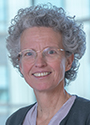
Marjan Meinders, PhD
Center of Expertise for Parkinson & Movemenet Disorders
Radboud University Medical Center
Nijmegen, the Netherlands

Wits Donald Gordon Medical Center